
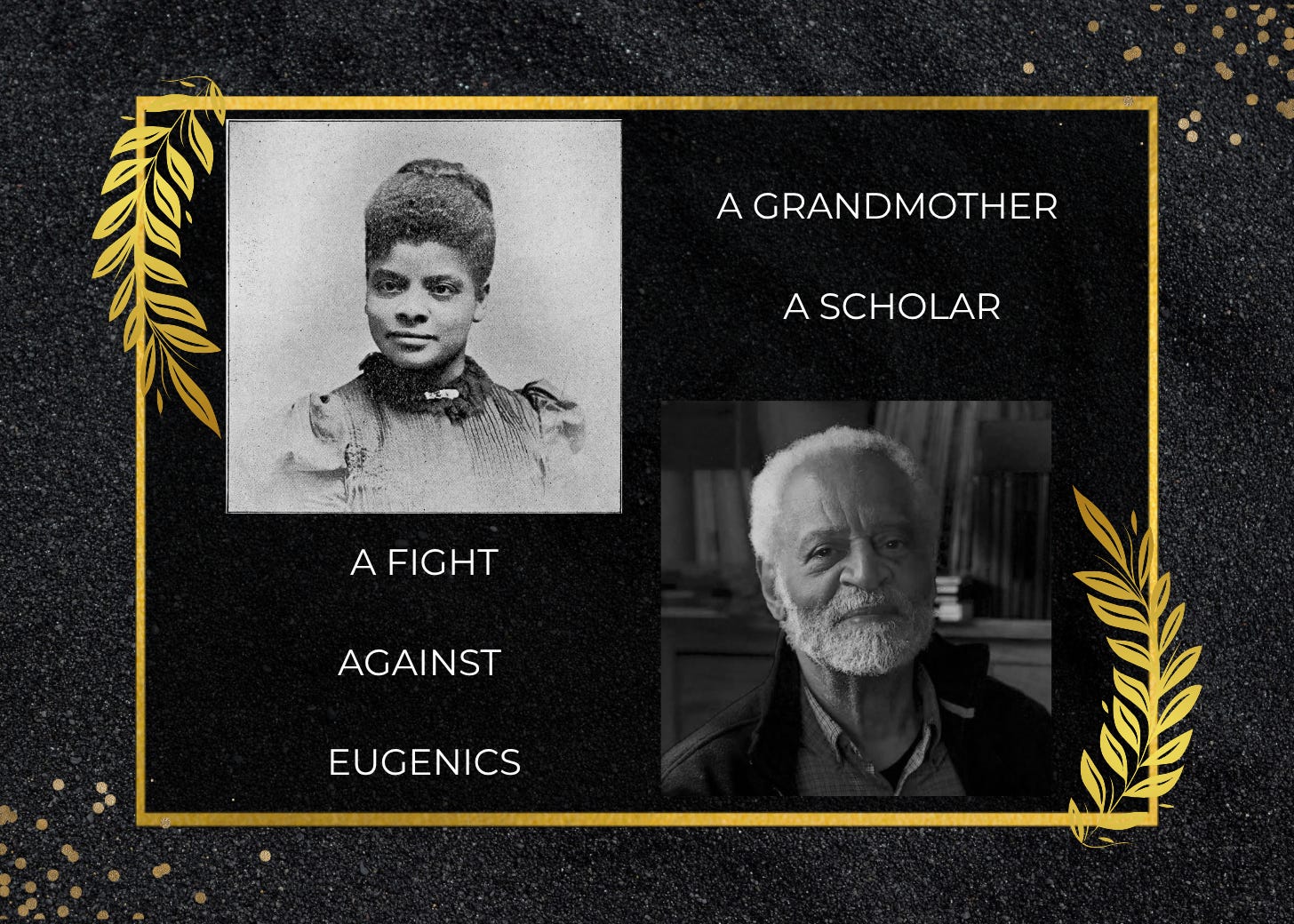
Troy Duster, a UC Berkeley sociologist, spent his career documenting how social assumptions sometimes shape what we accept as science. His grandmother, Ida B. Wells, would have been proud of him.
Wells was born into slavery in 1862 yet became a schoolteacher in Memphis. In 1884 she was forcibly removed from a train car because of the color of her skin. She sued the railroad and initially won, though the ruling was overturned on appeal. In 1889 she became co-owner of the newspaper Free Speech and Headlight; her exposés on conditions in the city’s Black schools cost her a teaching job.
Then, in March 1892, a white mob in Memphis lynched three of her friends, Black businessmen who owned a grocery. Wells doubted the popular justification that that lynching was a response to terrible crimes. She investigated the cases herself, interviewing witnesses and other reliable sources. After she published her findings, disputing the original accounts, a mob destroyed her newspaper’s office, and she was warned not to return. Her report appeared in the pamphlet Southern Horrors in 1892 and, in 1895, in A Red Record, which relied on statistics, interviews, and narrative evidence. She carried the case to audiences across the United States and Britain.
Well’s grandson, Troy Duster, shared her concerns about the effects of prejudice on evaluating social events and conditions. He joined the UC Berkeley faculty in 1970, the year his first book, The Legislation of Morality, was published. Duster served on the National Advisory Council for the Human Genome Project and the President’s Commission on Mental Health, and in 2004 was named president of the American Sociological Association, among many other accomplishments.
The Legislation of Morality investigated how drug use was recast from a health problem into a criminal one as addiction spread into the inner city. The book’s insights into the racial underpinnings of drug policy had real impact. At a 2014 tribute, U.S. District Judge Thelton Henderson said Duster’s work had been a revelation to him and contributed to his opposition to mandatory sentencing for crack cocaine, a policy that precludes individualized sentencing that considers the implications of drug addiction for an offender.
In 1990, Duster published Backdoor to Eugenics, which warned that new genetic technologies must be used thoughtfully, else they might bring the unscientific and harmful logic of eugenics back into medicine and public discourse, without any deliberate intent.
Duster delved deeply into the social aspects of genetic discoveries. His colleagues have described him as someone who could talk to geneticists about how society works and to sociologists about how genes work. That fluency is what makes Backdoor to Eugenics unusual.
The thesis of Backdoor to Eugenics
The book’s first chapter opens with the Inquisition, when purity of blood became a biological argument for persecuting Jews. Duster traced how biological claims have long been recruited to justify social hierarchies. While eugenics in its twentieth-century form, the dogmatic old-line thinking about race and ethnicity that was widespread around the turn of the century in the United States, was discredited by many studies after World War II. Duster was concerned that eugenics did not so much vanish as go underground.
He understood that the new genetic technologies, including carrier screening, newborn screening, and prenatal diagnosis, can be lifesaving and improve health outcomes. When he wrote his book, mandatory newborn screening already covered a sizable share of the population, prenatal diagnosis of several hundred genetic disorders was possible, and state and national registries were collecting information on these genetic traits for millions of infants. Duster raised concerns about how modern institutions would handle this deluge of highly sensitive information, whether scientific analyses of genetic data and health outcomes would properly evaluate critical social factors. He warned that the findings of genetic science could be, and in some cases already were being, seriously misinterpreted by the public.
Populations differ in the frequency of disease-causing variants for ordinary evolutionary reasons. Selection can maintain a variant that is harmful in two copies but protective in one; a classic example is the sickle cell allele, where one copy offers some protection against malaria and two copies cause sickle cell disease. Populations that were historically isolated, or descended from a small group of founders, also tend to carry certain variants at higher frequencies. The BRCA1 and BRCA2 founder mutations are a case in point: about one in 40 people of Ashkenazi Jewish ancestry carry one such mutation, compared with about one in 400 in the general population. In response, Israel has created a national program offering BRCA screening to Ashkenazi Jewish women. Those found to carry a mutation can begin earlier cancer screening and consider preventive surgical measures that can save lives.
So screening programs that target a higher-risk group are not scientifically wrong, and they are necessary.
Duster’s warnings were about misconceptions. He documented a growing propensity to explain crime, mental illness, and even intelligence as expressions of genetic predisposition. He cautioned that this tendency leads us to ignore evidence about social and other causes of those problems, crippling our ability to address root causes.
Another danger Duster spoke about is of eugenics returning by the back door: through discrimination (deliberate and also inadvertent) against people carrying an ever-larger selection of “genetic defects” and “genetic disorders.” Other important figures have spoken to various concerns about genetic screening of ethnic populations and of groups of workers. Al Gore said that genetic screening “has potential to serve as a marvelous tool to protect the health of workers or a terrible vehicle for invidious discrimination.” Health conditions caused by a work environment can be blamed on genes as a way for employers to avoid bearing responsibility for the consequences of inadequate protection of workers.
Serious mistakes have been made, as when the Air Force Academy in the 1970s excluded applicants with only one sickle cell gene when carrying one gene has no relevance to fitness. Also worth considering: if information from genetic screening by employers for disease prevention is not kept confidential, it can impact people’s ability to obtain important protections. The Genetic Information Nondiscrimination Act of 2008 addresses this only partially: it does not cover life, disability, or long-term care insurance, and its employment provisions do not apply to employers with fewer than 15 employees.
Held carefully, ancestry-linked knowledge saves lives, as BRCA testing in Ashkenazi Jewish families shows. Handled carelessly, it risks our privacy and risks reviving harmful and unscientific aspects of the eugenics movement. Duster provides helpful suggestions in his book for how to manage new genetic findings about populations thoughtfully, while warning about the importance of conveying findings in a careful manner that is understandable to lay people.
Why this matters now
Ever larger databases of personal genetic information are being created. In England, the Generation Study aims to sequence the genomes of up to 100,000 newborns to look for more than 200 conditions that can be treated early in childhood. Parents choose whether to take part, and organizers say the data are held in a secure research environment.
Duster long ago saw the risks of such databases. In 2011, he and co-author Peter Chow-White warned that health DNA databases hold mostly samples from people of European origin, while forensic databases disproportionately hold samples from African American and Latino people. Who builds these databases, who controls them, and what those people believe about human worth are not side issues.
In my opinion, recent events should make us more watchful, not less. Elon Musk, who led the Department of Government Efficiency in 2025, has warned that low birth rates are “one of the biggest risks to civilization.” Pronatalism is not eugenics by definition; wanting more babies is not the same as wanting certain kinds of babies. But the two can be promoted as a package. The Washington Post reported in July 2025, citing unnamed sources, that Musk and his partner Shivon Zilis used a startup called Orchid, which sequences embryos, for special screenings meant to gauge intelligence potential. Orchid contest this, claiming it does not try to predict a child’s intelligence, and the report has not been confirmed. Zilis had earlier told Musk’s biographer that he really wants smart people to produce smart kids. Selecting for “smart people,” sold as a private choice and a market product, is exactly the back door Duster described.
I think we should not trust those running powerful data systems to protect our genetic privacy just because they say they will. Under DOGE, according to earlier disclosures, staffers improperly shared sensitive Social Security data and circumvented IT rules. A whistleblower complaint filed in 2025 alleges that DOGE-affiliated staff copied the Social Security Administration’s master database, which holds the numbers and personal details of more than 300 million Americans, into a poorly secured cloud environment. The agency says the data are walled off and that it knows of no compromise. The agency’s inspector general and members of Congress are now reviewing claims about misuse of the data. The negative allegations remain to confirmed, but they are exactly the kind of claims that ought to give us pause about how institutions will handle our most personal information, including the coding of our individual genomes.
At worst, bureaucracies and other organizations may deliberately violate genetic privacy; in other cases, despite good intentions, institutions and others in powerful positions may do an inadequate job of protecting confidential genetic information.
Ida B. Wells refuted the flawed explanations of the brutal lynchings of her friends. Her grandson investigated what happens in society when poorly told stories about genes go unchallenged. We should carry on their tradition of careful, brave, and persistent inquiry, and make efforts to spur public discussion of these matters before widespread screening of babies whole genomes is adopted.
Lots of crucial information and fascinating. Good for you!!!
This is such a thought-provoking piece. I think the ending sums it up very well.