
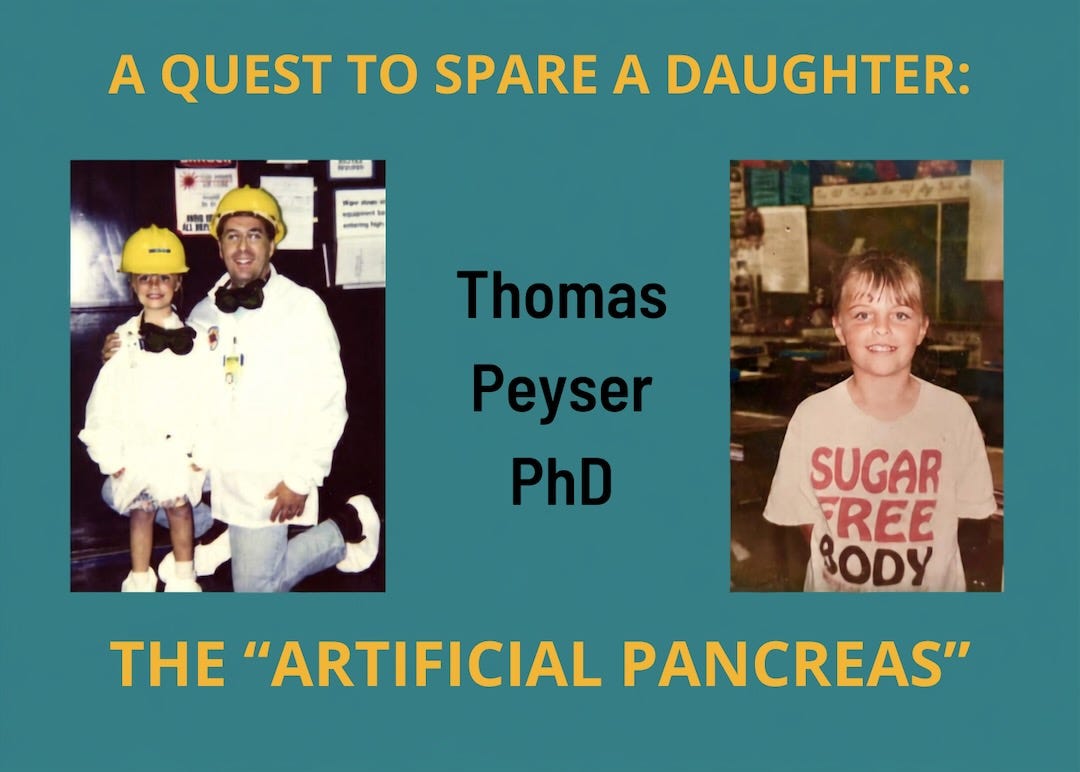
Today I’m writing about my husband, Thomas Peyser, as a classic example of how personal anguish, worry and love can motivate people to push relentlessly to achieve breakthroughs in science and medicine. We were devastated when at the age of seven and a half, our daughter Genny was diagnosed with insulin-dependent diabetes mellitus. Soon after, Tom — then an established plasma physicist at Lawrence Livermore National Laboratory — made a decision that reshaped our lives, the rest of his career, and, ultimately, helped improve the lives of millions of people with diabetes.
Because of fortuitous coincidences during Genevra’s initial hospitalization, Tom was propelled into wrestling with a scientific problem that had become urgent in our personal lives: how to give people with diabetes a reliable, continuous window into their own glucose levels, and how to eventually use that information to deliver insulin automatically. That goal — what the field calls automated glucose control — drove everything that followed.
On May 14, 1994, I took our daughter to our local medical center for what I thought was a sore throat that wasn’t clearing. Genevra had lost some childhood chubbiness recently, but she was athletic; we thought that as a seven-year-old she was simply slimming down. I’m a psychiatrist, but I did an internship in internal medicine, a true blessing given what we were soon to face. I told the covering pediatrician that our daughter was losing weight and asked that she be checked for diabetes — not because I thought she had diabetes, just using my Hopkins MD training to rule out worst-case scenarios.
The lab work was a shocker. Gen’s blood glucose was critically elevated, and she was admitted immediately to Lucille Packard Children’s Hospital at Stanford. I reached Tom at Livermore from the clinic office — no cell phones then — and told him the news, then drove as fast as I could with her to Stanford.
The endocrinologist who admitted Gen that early evening, by chance, was Darrell Wilson, MD — a physician who would turn out to be not just her doctor, but the unexpected catalyst for Tom’s new scientific life and a lifelong friend to our family.
The first day or two were a traumatic blur, and of course especially hard on Gen, whose life was upended. The first evening, she was frightened that the nurses were planning to insert “ivy” into her veins — the IV desperately needed to infuse the insulin her body was failing to make. I slept with her in her hospital bed that night, holding her in my arms as she cried each time her fingers were pricked repeatedly to make sure her glucose levels were coming down.
Sometime in those first few days, Dr. Wilson discovered that Tom worked at Lawrence Livermore and asked if he knew Carl Haussmann — one of the scientists who shaped the lab from its earliest days. Haussmann, a pioneer in high-powered laser technology, was also Dr. Wilson’s father-in-law. Wilson had ideas about how Livermore Lab’s sophisticated technology might be brought to bear on a problem that was bedeviling diabetes care and standing in the way of what endocrinologists considered the Holy Grail: creating an automated glucose control system that doctors believed would transform the lives of people with diabetes.
The biggest challenge was inventing a way to monitor glucose continuously and automatically, without constant fingersticks. If a sensor could be created capable of doing this properly, experts thought it would be hard but feasible to develop an algorithm to process the information from a reliable sensor and “tell” insulin pumps — which were coming into wider use at the time — how much insulin to deliver, and when. Such an automated feedback loop would do what the pancreas of people with diabetes could no longer accomplish: give them constantly adjusting doses of insulin to meet the demands of their bodies.
Within three months of Genevra’s diagnosis, Tom was working to create a glucose sensor that would ultimately lead to the development of “artificial pancreas” systems.
The Missing Piece
A word of scientific context: in 1993 — the year before Genevra was diagnosed — the landmark Diabetes Control and Complications Trial (DCCT) published its findings after ten years and more than 1,400 subjects. The trial proved definitively that tight glucose control dramatically reduced the devastating long-term complications of type 1 diabetes: blindness, kidney failure, nerve damage, and cardiovascular disease. But achieving tight control required testing glucose at least four times a day by fingerstick — a painful, burdensome regimen that most patients could not sustain (and still cannot, even though fingersticks have become less painful with better engineering). Also, it is very hard to learn exactly how to correctly adjust insulin doses depending on how one’s glucose levels are fluctuating.
Tom dove into a field well outside his expertise, but he brought to bear many tools of a plasma physicist: first, confidence that he could solve complex scientific problems, but also expertise in spectroscopy, fluid dynamics, and the rigorous quantitative thinking that a career at one of the world’s premier research laboratories had trained him to apply. Lawrence Livermore’s top leadership was highly supportive. Carl Haussmann called Tom in shortly after Tom’s return to the lab and strongly suggested that he begin working on this problem immediately, alongside his primary responsibilities.
Tom agreed. His first task was to investigate claims that others were on the verge of solving the sensor problem. If so, there was no role for LLNL — but if the claims proved false, the lab would take it on under Tom’s leadership. Tom discovered that the problem was nowhere near solved. Through another of the coincidences that seem to have marked this chapter of our lives, Tom’s father — a Hollywood writer and a flaming extrovert — hit it off at a party with someone who connected Tom to scientists at MiniMed, the pioneering diabetes device company founded by Alfred Mann. A collaboration was formed.
I helped Tom a little, drawing on my experience writing grants during my time on the Johns Hopkins faculty when he and collaborators he’d enlisted submitted a proposal to the National Institute of Standards and Technology’s Advanced Technology Program. They were awarded more than six million dollars in funding.
The LLNL-MiniMed team developed a fluorescent glucose sensor using a short-wavelength molecule that selectively binds to glucose and increases its fluorescent signal upon doing so — a genuinely new detection approach. For this work, Tom received both the Department of Energy/White House Office of Science and Technology “Bright Lights” Award and the Federal Laboratory Consortium Award for excellence in technology transfer. The name “Bright Lights” has always struck me as particularly apt for a man who’d spent his first career studying plasmas and blindingly bright lasers.
Eventually Tom had to choose between satisfying his day-to-day boss at the Lab and pursuing his mission to alleviate the burden of diabetes — for Genevra and for others worldwide. We were apprehensive when he left a steady job for a world unknown to him: small tech companies in Silicon Valley. Tom was shocked to discover that the first company was distorting data in a major way. Tensions rose until finally Tom resigned. Immediately, the CEO rushed him out of the office, then, flustered, had to call Tom on his cell phone (they existed by then) since the CEO had forgotten to ask for the company’s keys back!
At the time, I was working at the Menlo Park VA running a large geropsychiatric consult service and moving into an academic position at Stanford. We decided to stifle our fears and find ways to manage on my salary until Tom could find a better fit in a reputable company.
Jumping forward: by 2005, Tom was working at Abbott Diabetes Care, where he contributed to the science behind the FreeStyle Navigator CGM system, and then at GluMetrics, trying to develop intravascular glucose monitoring for critically ill patients. From 2011 to 2013 he served as Vice President of Science and Technology at Dexcom, leading the company’s artificial pancreas research and its collaborations with academic groups including the team at UC Santa Barbara and the Sansum Diabetes Research Institute.
As a result of one more fortuitous connection, Tom offered to assist a family navigating their child’s dramatic glucose swings. He convinced the mother, orthopedic surgeon Jennifer Schneider, to put her four-year-old on a newly developed continuous glucose monitor. Dr. Schneider became committed to further improving this technology. She and Tom eventually co-founded AGC — Automated Glucose Control LLC — developing software solutions to help insulin pump companies commercialize artificial pancreas systems.
Before AGC became a funded company, Tom had consulted widely across the diabetes device landscape, learning as much about the psychology of wishful thinking and self-deception in industry as he did about how to bring products to market.
What Tom contributed across these roles was not developing a single device, but something more foundational: improved scientific standards that made continuous glucose monitoring trustworthy. The core challenge was not proving that a sensor could work once in a laboratory — it was proving that sensors could work reliably enough, accurately enough, and consistently enough for a patient to use CGM data to make potentially life-or-death insulin dosing decisions. That shift — from a sensor that monitors to a sensor that guides treatment — required a rigorous body of evidence about accuracy, calibration, and performance. Tom was one of the scientists who built that evidence base, collaborating with other key scientists and doctors to complete numerous clinical studies and publish the results in significant medical journals.
Tom also wrote numerous papers analyzing progress and shortcomings in what was being done to advance diabetes technology. One paper applied standard physics data visualization tools to glucose sensor data. Another paper done with the Mayo Clinic proved that sensor glucose data was closely correlated with blood glucose data, using isotope tracking methods. Papers like this enabled the FDA to approve glucose sensors to replace fingersticks in dosing insulin.
Where does Tom sit in the history of this field? A recent synthesis of the CGM industry’s key contributors — drawing on interviews with longtime insiders including MiniMed’s Chief Scientist William Van Antwerp — placed Tom among the most important scientists in the modern era of CGM and on any serious “top ten” list of contributors to commercial CGM and automated insulin delivery. The assessment described him as one of the leaders of the generation that made CGM accurate and trusted, who “repeatedly pushed the industry toward higher sensor accuracy, reliability, and eventual insulin-dosing use.” Tom appears in that history as one of the scientists who made the enterprise scientifically credible — establishing performance standards without which no automated glucose control system could be safely employed.
The devices on the market today — including the MiniMed 780G, the Omnipod 5, the Tandem Control-IQ, and the iLet Bionic Pancreas — are the realization of the vision that Tom and his colleagues worked toward. “Closed loop” systems usually can deliver better glucose control than even the most motivated patients can achieve with frequent fingersticks and complex responses to changing glucose levels. No longer do people suddenly have to give unexpected, painful insulin injections or correctly instruct an insulin pump what to infuse. And of course, often things seem to go wrong for people with diabetes at the most inconvenient times. The current automated glucose control systems can significantly reduce the burden and constant stress of patients who must manage constantly changing glucose levels with highs and lows that can make them feel awful. These technologies continue to advance. But already, they have transformed in a remarkable way what it means to live with type 1 diabetes.
Genevra is now in her late thirties. She has lived with type 1 diabetes for more than thirty years, and she has experienced the benefits of the technology for managing her disease advance. It’s been liberating for her to move from multiple daily finger pricks and many daily insulin injections to the continuous, automated systems that exist today — systems whose scientific foundations Tom helped to lay. Gen utilized each advance as it arrived. These innovations gave her hope that her life would become progressively less centered around diabetes. Now she is a painter and made it successfully through a challenging pregnancy by using a DIY insulin delivery system Tom’s colleagues had built that met Gen’s own exacting standards — before commercial devices were quite good enough to satisfy her. Gen is now enjoying mothering our healthy and joyous six-year-old granddaughter.
Those who manufacture such technologies report the following statistics for users in the United States today: 5.6 million people use continuous glucose monitors (valuable for many people with diabetes whether or not they use insulin), and between 800,000 and 1.3 million people are using automated glucose control systems. More people with diabetes are switching to automated control systems every day.
Tom’s path was jagged, and several times I had to dial up my full-time practice to keep the lights on at home. But I have been an enormous supporter of Tom and Genevra’s journey, and I am tremendously proud of them both. Sometimes it takes a family — and a village. And it takes worldwide collaboration among scientists, government agencies, and businesspeople to bring a vision into reality.
Wow! I learned a lot I didn’t know. Very powerful. Thank you for sharing
Comprehensive and powerful.