
As subscribers know, in this Substack I’ve been exploring the intersection of medicine, genetic testing, science and personal stories, a topic that has interested me for decades.
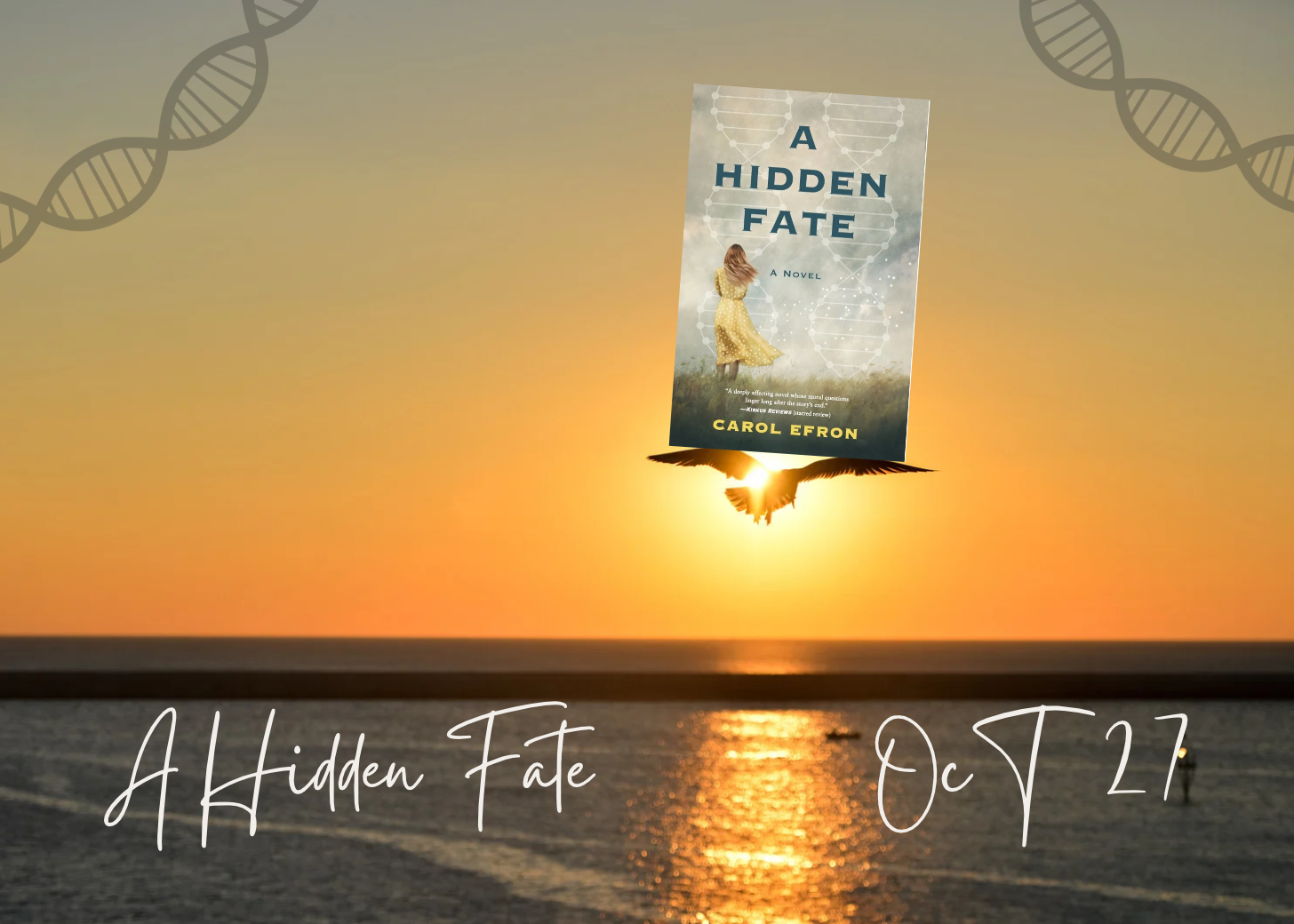
My debut novel, A Hidden Fate, gets its fuel from that intersection. It comes out next Tuesday, 10/27, from She Writes Press. The Kirkus starred review (1) commented: “This novel hauntingly ruminates on questions of destiny and free will, asking readers whether they would want to know their fate in the face of certain death. Drawing on her own experience as the director of the Huntington’s clinic at Johns Hopkins, Efron imbues Julia and her family with remarkable emotional authenticity, rendering their plight with a compassion that makes the narrative all the more poignant… the richly drawn characters and the emotional depth of Julia’s journey make for a deeply affecting novel whose moral questions linger long after the story’s end.”
The theme of whether we want to know our destiny has preoccupied people since at least the time Oedipus was written. There have been several excellent novels about characters with Huntington’s disease (HD) and about the daunting choices that at-risk face. For example, Lisa Genova’s novel Inside the O’Briens (2015) vividly portrays a family where the father (a policeman) is afflicted with this devastating illness, provoking agony and turmoil for every family member.
So what’s different about A Hidden Fate? The novel stands out in its coverage of genetic testing issues but also touches on many other themes.
To dramatize genetic testing for HD, I set the novel in 1986, when we hadn’t located the gene for HD but knew its approximate location (on the short arm of chromosome 4). At that time, if someone at risk wanted to know if they’d inherited the fatal gene, getting an accurate answer required involving multiple family members. And we needed to analyze DNA markers of relatives with and without the illness, relatives who were willing to give blood samples - and willing to be examined to determine whether they were affected though unaware of their situation. Getting relatives to agree to exams wasn’t always easy. Some knew in their hearts that they were ill but weren’t ready to face it; others weren’t close to the person at risk and didn’t want to bother; still others, who were healthy, wanted to stay as far from the world of Huntington’s disease as possible.
I therefore had to provide relatives for Julia with and without HD to give her any chance of uncovering her genetic fate in that era. But my vision began with a woman whose father deceives her about her risk because he can’t bring himself to disclose such painful news.
So, I had to create a wing of Julia’s family that her father has kept hidden so that she would not learn the truth of her mother’s genetic illness. In the Comptons, the large family I envisioned, some of Julia’s five cousins already have the illness in their 20s, due to paternal inheritance of the gene for HD.
Creating this family gave me another way to show readers what Huntington’s disease does to the people it brutalizes, at different stages of the illness, and how those still at-risk cope with profound uncertainty about the future. It also gave Julia people to talk with facing similar decisions themselves so that her internal debates about testing are complemented by conversations with relatives who have their own experiences and views about learning what is written in their DNA.
Because I ran the Huntington’s clinic at Johns Hopkins when presymptomatic testing for HD first became available (only there and a Harvard hospital), the impact and the complexities faced by people at risk for HD are deeply embedded in my consciousness. Readers have blogged that I convey the scientific issues clearly while drawing them into a “dramatic emotional ride”.
The story is described well by my first Goodreads reviewer Romy (2) so I won’t repeat the plot, but I want to mention some key themes and questions the novel explores, which may interest some of the millions of people who have never heard of HD:
1. What and when should one disclose about medical threats one faces (or might face) to one’s employer, to one’s child, to friends, early in dating, when applying to college or college or grad school, to one’s peers at work? When is it appropriately self-protective to remain quiet, and when does keeping serious medical matters secret become unethical, as in the case of a pilot or a surgeon who might endanger passengers or patients as their motor control deteriorates? Finally, what is the emotional cost of keeping such information secret? Of disclosing it?
As a psychiatrist, I’ve worked with many people with a wide variety of mental health and physical problems who struggled with what to disclose, to whom, when, and what to hold private, so again, I’m drawing on a wealth of experience when I create fiction.
2. How does a daughter still grieving from losing her mother to psychosis and then to death recover from her childhood trauma and pain? What is the role of love from friends and family in this process? Of involvement with nature and art? What is required of the daughter to heal? What is the impact of losing her mother on her feelings about becoming a mother herself? How do Julia’s cousins deal with the grief about what has descended on their family and, for some of them, with the profound uncertainty of not knowing their future?
3. How can a couple resolve a profound conflict and/or deal with the damage it has wrought on their relationship? At the heart of my novel is an unusual love story - not girl meets boy, but what happens when a loving, committed couple faces choices that are truly agonizing – and the partners discover to their surprise that their desires and convictions about what they should do in a situation no one should have to face are diametrically opposed. Advance readers have been moved by Julia and Matt’s fraught and dramatic journey as they navigate what divides them and try to repair the damage their tough choices have done to each other.
4. What was it like to deal with the intense pressures of graduate school? The novel’s example is physics: Julia’s idealistic husband studies plasma physics, (as my husband did in the mid-1980’s.) Of note, Julia’s fervent desire to become a historian plays an important role in the novel too, but she is more secure in her professional life than is Matt, but for her health challenges.
5. What happens during pregnancy to a woman facing serious conflict with her husband and at the same time dealing with major threats to her future health and well-being? How does she find the strength to continue in her career? Should she even soldier on, or should she find a way to be under less intense pressure in at least one domain of her life?
6. What kinds of certainty do we need and when might it be better to live with uncertainty and hope? How do people differ in this regard? (There are no right answers)
A Hidden Fate is not didactic, and I hope that my focus here on the issues it raises doesn’t suggest otherwise. But in addition to launching my novel, I want to talk about what’s happening in our society. The pros and cons of various genetic tests are not a stale issue. On the contrary, all kinds of genetic testing options are coming into our lives at an incredible pace. There are rapidly advancing plans to test the entire genome of newborn babies in England. This raises serious concerns about whether sensitive genetic data will be protected; about what will be disclosed to parents regarding untreatable adult-onset genetic diseases; and about preserving the right of babies to wait until adulthood and decide for themselves what they want to learn about their genetic future, when no steps available in childhood can prevent a late-onset illness. I wrote a Substack on the complexities of these issues, and I hope you will read it (2)
The tale of couples navigating the divide of opposing beliefs and convictions also is more relevant than ever in the United States today, given the emergence of dramatic political differences.
I came to this story as a physician, with a background in genetics and neuropsychiatric illness, and as a former faculty member at the Johns Hopkins and Stanford schools of medicine. The novel began in a dream so insistent that I couldn’t ignore it. After writing four chapters I realized I needed professional guidance and embarked on a quest to learn how to write excellent fiction. It took ten years. I am not Tolstoy, but I think I’ve crafted an engaging and important novel that will move readers and will spark deep discussion among friends and at book clubs.
A Hidden Fate will be available as a paperback, an e-book and an audiobook. I hope you will read it and let me and others know what you think of the work as a novel and of the issues raised (3).
Kirkus review of A Hidden Fate:: https://www.kirkusreviews.com/book-reviews/carol-efron/a-hidden-fate/
Substack on whole genome testing of newborns:
My author website: https//:www.carolefron.com

Exciting and the book sounds intriguing. Congratulations!
I look forward to reading it, Carol.