
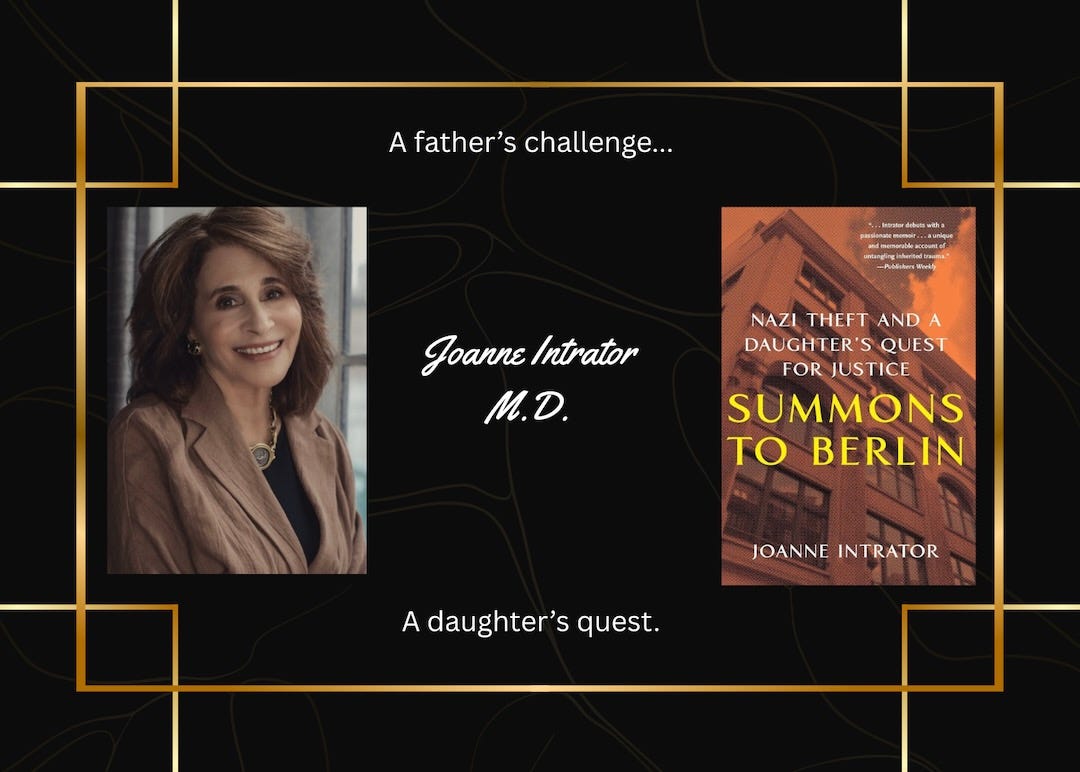
Growing up in New York City, Joanne Intrator knew that Nazis had murdered some of her German relatives and stolen her family’s business. Her parents, German Jewish refugees, had fled with almost nothing. Haunted by the emotional burden they carried, she found herself asking a question that would shape her adult life: How does the capacity for such terrible cruelty take root in a human soul?
Many children and grandchildren of Holocaust survivors have asked versions of that question. Dr. Intrator pursued it with unusual persistence. She became a psychiatrist, brain-imaging researcher, forensic expert on psychopathy, and eventually spent nearly a decade seeking restitution for property the Nazis had stolen from her family, then wrote a memoir to tell the intertwining stories.
Intrator’s memoir, Summons to Berlin, describes the intersecting paths she followed: different ways to explore and confront human evil and its consequences.
Examining psychopathy
After graduating from Columbia University’s College of Physicians and Surgeons in 1981, Intrator trained in psychiatry at St. Vincent’s Hospital, affiliated with New York Medical College. She then completed a forensic psychiatry fellowship at Albert Einstein College of Medicine.
Dr. Intrator was mentored by Robert Hare, the Canadian psychologist whose Psychopathy Checklist–Revised, or PCL-R, helped make rigorous research on psychopathy possible. The 20-item instrument combines a structured clinical interview with records review to assess traits and behaviors such as pathological lying, shallow affect, lack of empathy, and criminal versatility. Rating scales and structured interviews, in various domains of medicine, have been shown to be more reliable and thorough than relying only on clinical impressions and diagnoses.
Psychopathy is not identical to the DSM-5 diagnosis of antisocial personality disorder. Antisocial personality disorder is a broad, behaviorally defined condition, characterized by a persistent pattern of disregarding or violating the rights of others. People with antisocial personality disorder may be irresponsible, deceitful, impulsive, aggressive, or criminal, yet still retain the capacity for emotional attachment, guilt, or remorse. Psychopathy describes a narrower, far more malignant pattern, marked not only by antisocial behavior but also by profound callousness, a striking absence of empathy, guilt, and remorse, habitual manipulation, shallow emotions, grandiosity, and sometimes superficial charm. In Hare’s formulation, those with psychopathy often treat other people not as fellow human beings but as objects to be used, controlled, or discarded. This distinction is central to psychiatric and forensic thinking. The PCL-R allowed Dr. Intrator to identify and study a far more specifically characterized group than a simple history of antisocial or criminal behavior could identify.
With Hare as a collaborator, Intrator asked whether people with psychopathy process emotional language differently. What happens in the brain when they encounter words such as “love,” “fear,” or “murder”? Using SPECT—an imaging method that measures cerebral blood flow as a proxy for brain activity—Intrator and colleagues studied male inpatients at the Bronx Veterans Affairs Medical Center. Participants, characterized through clinical interviews and the PCL-R, were shown emotional and neutral words while undergoing imaging.
Dr. Intrator’s 1997 paper in Biological Psychiatry, co-authored with Hare and colleagues, was the first nuclear brain-imaging study of psychopathy.1 Its findings suggested that people with psychopathy did not merely have blunted responses to emotional words; they also showed unusual cerebral blood-flow patterns, including atypical temporo-frontal activation. The researchers proposed that in people with psychopathy, emotional language may be routed primarily through cognitive rather than emotional circuitry—so that “I love you” or “I will kill you” are processed more like a problem to solve than an emotionally meaningful experience.
A second mission: Berlin and a seized factory
While Dr. Intrator was conducting this research, she was also engaged in a related but deeply personal struggle.
When her father died in 1993, he left her with a challenge: “Are you tough enough?” He was asking whether she would continue his effort to obtain restitution for a major commercial building at 16 Wallstrasse in central Berlin, seized from his family by the Nazis in 1936.
German reunification had created a restitution process, at least in theory. But the process was arduous, costly, and emotionally draining. Intrator spent nearly a decade navigating German legal and bureaucratic systems that often seemed designed to exhaust claimants rather than assist them.
As a psychiatrist, Intrator recognized patterns of evasiveness, stonewalling, and avoidance of accountability. Yet recognition did not make this much easier to endure. At one point, she was advised to split the proceeds with the daughter of the Nazi who had stolen the building—a woman who claimed Intrator’s grandfather had lost it because he was an incompetent businessman, not because he was Jewish.
Dr. Intrator persisted. After years of legal maneuvering, traveling between New York and Berlin, and dealing with the intense emotions and trauma generated by her experiences, she prevailed. The German government paid restitution, though the victory came at a steep personal cost, including serious strain on her marriage.
Along the way, Dr. Intrator discovered that her family’s building had been used to manufacture Nazi flags and one million yellow stars—the same stars Jews across Nazi-occupied Europe were forced to wear—a bitter, unexpected irony.
The memoir
In Summons to Berlin: Nazi Theft and a Daughter’s Quest for Justice, published by She Writes Press, Intrator recounts her nine-year ordeal. She brings her clinical eye to the lawyers, bureaucrats, denials, and moral distortions she encounters. The book is at once a legal memoir, family history, and psychological study of how a nation confronts—or evades—the moral burden of its past. It is also an insightful self-reflection as Dr. Intrator explores the process by which she developed the strength and resilience that enabled her to endure this harsh experience, evocative of the brutal past, to persevere, and ultimately to achieve justice.
Publishers Weekly called the book a “unique and memorable account of untangling inherited trauma.” The Forwardpraised its precision and candor, while noting the steep psychological costs of the restitution struggle.4
Dr. Intrator’s historical research contributed to Stolen Heart: The Theft of Jewish Property in Berlin’s Historic City Center, 1933–1945, a 2017 exhibition at the Leo Baeck Institute at the Center for Jewish History in New York.
The throughline
Intrator’s childhood question—how do people become capable of horrific cruelty—does not have a simple answer. Her research, and the field she helped pioneer, have illuminated some aspects of the matter. Her memoir explores another dimension: what happens after cruelty has been committed, institutionalized, denied, rationalized, and passed down through generations, and how can humanists stand up to it?
Summons to Berlin is readily available in print, as are media interviews, including the Open Book television interview with John Gray for WTEN+.5
Postscript: where the science stands now
Nearly three decades after Intrator’s SPECT study, neuroimaging research on psychopathy continues to develop. Investigators have identified abnormalities in neural circuits utilizing the amygdala, orbitofrontal cortex, and paralimbic systems involved in emotion, motivation, and self-regulation in people with psychopathy. The focus has expanded beyond looking for abnormalities in only a few brain areas, or in their interactions. Kent A. Kiehl was a significant figure in developing the influential paralimbic-system account of psychopathy.2 More recently, a 2025 paper by Jules R. Dugré and Stéphane A. De Brito proposed a network-based approach that may help reconcile the field’s varying findings.3
Dr. Intrator and Hare’s original conclusion—that emotional information may be processed differently in psychopathy and that brain imaging can help reveal those differences—remains influential. The precise neural mechanisms are still being worked out.
One limitation deserves emphasis: much of the imaging literature, including Intrator’s foundational study, has focused on incarcerated or inpatient male populations. The neurobiology of psychopathy in women, non-criminal populations, and across cultures remains far less understood.
References
1. Intrator J, Hare RD, Stritzke P, et al. A Brain Imaging (Single Photon Emission Computerized Tomography) Study of Semantic and Affective Processing in Psychopaths. Biological Psychiatry. 1997;42(2):96–103. doi:10.1016/S0006-3223(96)00290-9.
2. Kiehl KA. A Cognitive Neuroscience Perspective on Psychopathy: Evidence for Paralimbic System Dysfunction. Psychiatry Research. 2006;142(2–3):107–128. doi:10.1016/j.psychres.2005.09.013.
3. Dugré JR, De Brito SA. Mapping the Psychopathic Brain: Divergent Neuroimaging Findings Converge onto a Common Brain Network. Neuroscience & Biobehavioral Reviews. 2025;176:106272. doi:10.1016/j.neubiorev.2025.106272.
4. Klein JM. “Finally, Her Quest for Restitution From Germany Succeeded.” The Forward, August 1, 2023.
5. Gray J. "Summons to Berlin." Open Book, WTEN+, August 25, 2026. www.youtube.com/watch?v=lDSUGokONPw
Carol honored me with her insightful discussion of my book. I am grateful that I ultimately had the will to make the best of a very difficult time.
Thank you Carol for such a succinct and insightful summary of Dr. Intrator’s work. It sheds new light on some of the most despicable social policies in history. It is also relevant today in understanding many current US government policies in which cruelty is a feature not a bug. It helps us answer the question the Democratic nominee for Vice President in 2024, Gov. Tim Walz, asked so often on the campaign trail, namely “what is wrong these people?”