
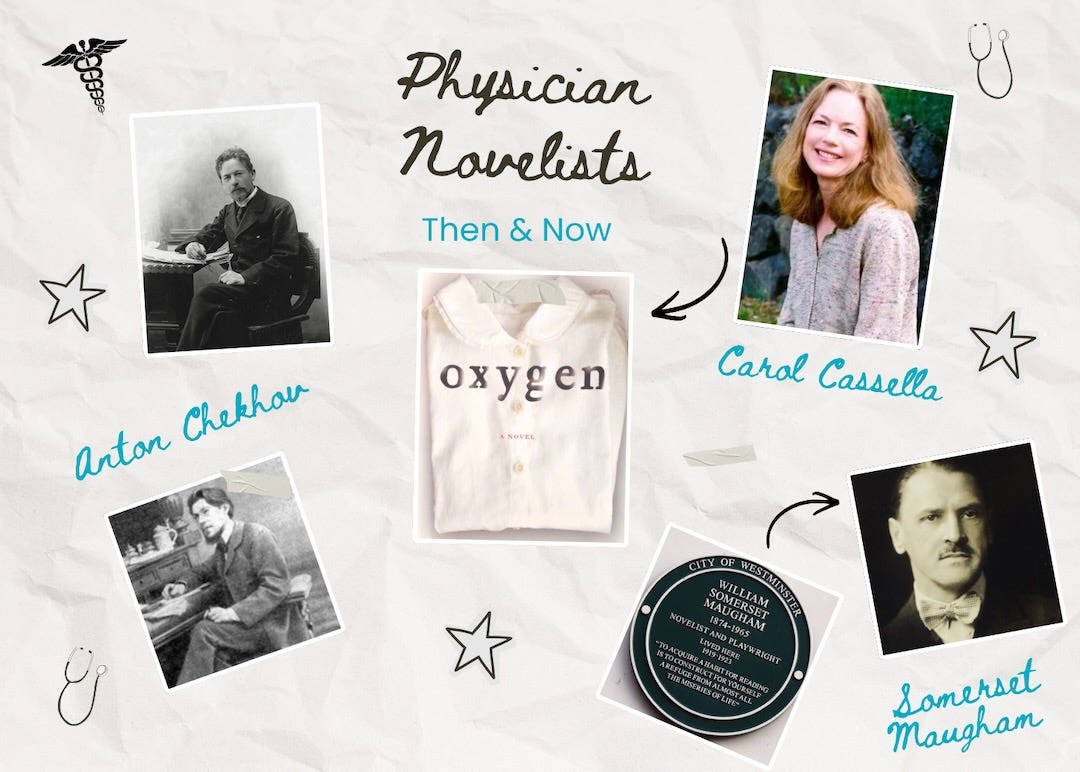
Many famous novelists have been physicians, and the tradition continues to provide excellent literature for us all. Today I’m writing about why this is no coincidence.
Somerset Maugham, who studied clinical medicine in London, wrote: “I learned pretty well everything I know about human nature in the five years I spent at St. Thomas’s Hospital”). He elaborated in his memoir The Summing Up: “I do not know a better training for a writer than to spend some years in the medical profession... I saw how men died. I saw how they bore pain. I saw what hope looked like, fear and relief.”
The neurologist Oliver Sacks, one of the great physician-writers of the twentieth century (though not a novelist), made a similar point: “In examining disease, we gain wisdom about anatomy and physiology and biology. In examining the person with disease, we gain wisdom about life.”
These two statements taken together capture something vital: medicine doesn’t just give writers material. It gives them access — to human beings stripped of their usual defenses, caught at moments of fear, hope, grief, and reckoning with their own mortality. It changes and enriches them as human beings. It is an apprenticeship in the extremes of experience that many people encounter rarely, if at all. And hopefully, it deepens empathy. Small wonder that so many physicians have felt compelled to write fiction and non-fiction for a general audience.
The list of physicians who became major novelists is longer — and more distinguished — than many readers realize. It spans centuries and continents.
Arthur Conan Doyle: trained as an ophthalmologist in Edinburgh and modeled Sherlock Holmes’s famous deductive method directly on his mentor Dr. Joseph Bell’s technique of clinical observation.
W. Somerset Maugham: Of Human Bondage, The Razor’s Edge, and The Moon and Sixpence — among the most widely read novels of the twentieth century.
Anton Chekhov: graduated from Moscow’s medical school and practiced as a country doctor throughout his literary career, treating thousands of peasant patients without charge while writing the stories and plays that would transform modern literature.
Walker Percy: trained as a pathologist at Columbia before contracting tuberculosis from his own cadavers, a transformative illness that led him to Kierkegaard, Dostoevsky, and eventually to a career as one of America’s most original Catholic existentialist novelists.
William Carlos Williams: worked lifelong as a pediatrician in Rutherford, New Jersey, writing poems between patients on prescription pads — and producing some of the most important American poetry of the twentieth century.
Michael Crichton: The Andromeda Strain while still a student. He graduated from medical school but never practiced, pursuing novel writing instead.
Abraham Verghese: an infectious disease specialist and internist now at Stanford, continues to practice medicine as he writes highly regarded and commercially successful novels.
Khaled Hosseini: The Kite Runner, written while he was still seeing patients, led to him becoming one of the best-selling novelists of the twenty-first century.
Less famous but excellent novelists like Carol Cassella and Victoria Dillon continue to practice medicine while they write compelling works of fiction. Cassella and Dillon are deserve broader recognition; both write compelling fiction leaving the reader with much to ponder after finishing the last pages.
Clinical medicine provides a stellar education — in observation, in the irreducible complexity of human beings under pressure, in a close look at what empathy looks like in stellar nurses as well as doctors. But it’s also worth noting that many go into medicine in part because they are intensely curious about other people, are empathic, and hope to understand others at a deep level as well as being able to help patients through medical challenges.
Anton Chekhov embodied the fusion of medicine and literature in an exemplary fashion. He graduated from medical school in Moscow in 1884 and labored as a dedicated physician for the rest of his life. He treated thousands of peasants free of charge in rural Russia. During the cholera epidemic of 1892 he served as the sole physician for a district of twenty-five villages. He built schools and roads and helped salvage a failing medical journal.
All the while, Chekhov was writing the stories and plays that would define modern literature.
He was explicit about what medicine gave him. When a friend urged him to give up doctoring and concentrate on writing, he refused, explaining that practicing medicine “significantly broadened the scope of my observations, and has enriched me with branches of knowledge whose true value for me as a writer can only be understood by someone who is a doctor himself.” He also wrote, “it seems to me that as a doctor I have described the sickness of the soul correctly.”
Some have called Chekhov’s approach “medical aloofness” — the objectivity required of a clinician taking a case history, turned on human character and behavior. I don’t find Chekhov’s writing aloof, just carefully observed and meticulous. Chekhov had a remarkable eye for the telling details that reveals what is happening beneath the surface. A gesture; a silence; depicting the way someone avoids a question. All small signs of a life under pressure, or joy bursting explosively through someone’s being.
One principle of writing Chekhov espoused was that “in general there ought to be nothing unnecessary.” As a doctor, one is trained to focus on essential elements of a case, and not be distracted by incidental findings.
Chekhov wrote about a wide variety of human experiences, and he also wrote sensitively about medicine. “A Doctor’s Visit” tells the story of a physician called to treat a young factory heiress; the physician realizes that her true illness is not in her body but in the conditions of her life. Chekhov frequently explored the ethics of medicine, created characters facing medical challenges, and portrayed over a hundred fictional physician characters in his stories and plays.
Chekhov understood that what people don’t say is as critical as what they say openly. Most doctors have cared for patients who conceal critical information — out of embarrassment, out of fear, out of denial that what is bothering them matters a great deal. Part of the subtlety of Chekhov’s fiction grows out of his understanding of these matters.
In The Cherry Orchard (1904), for example, the play revolves around what major characters will not face. Lopakhin tells Ranevskaya repeatedly and plainly that the estate will be auctioned unless she acts, but she cannot bring herself to acknowledge this truth. Her brother Gayev makes speeches to a bookcase. The family talks around the crisis — about Paris, about the past, about anything but the decision at hand — until the axe falls on the orchard in the final scene. The inability to speak plainly about what everyone knows and to act is central to the tragedy.
Other professions that have historically spawned great writers share a common quality with medical practice, involving practitioners in people’s lives when they are most vulnerable and most laid bare. Military experience gave us Tolstoy, Hemingway, and Heller. These men witnessed collective extremity and institutional absurdity early in their lives, experiences that forever marked their perspectives.
The law gave us Kafka, whose years in insurance bureaucracy are inseparable from the nightmare logic of his fiction, and Scott Turow, who wrote Presumed Innocent on his commute to work as a federal prosecutor. Journalism gave us Dickens, García Márquez, and Orwell — writers for whom the obligation to render inner and societal truths faithfully was ingrained by the time they turned to fiction. The sea gave us Conrad and Melville.
What these callings share with medicine is not just subject matter but access: to human beings under pressure, stripped of the composure they maintain in ordinary life, revealing — whether they intend to or not — who they are at the deepest levels of their psyches.
I went into medicine because I wanted to combine my fascination with people with my love of science. After decades of witnessing people at their most stressed and exposed, as well as in more routine life adventures, I’d amassed a wealth of experience to reflect on when I turned to writing fiction. Still, late in the revision process of A Hidden Fate, my debut novel, an insightful editor told me I wasn’t getting close enough to my characters’ inner lives. I was surprised; as a psychiatrist I knew I understood a great deal about many people’s inner lives. But I discovered that I had more to learn about how to render inner experience on the page — how to make a reader feel what a character feels, not just understand it intellectually.
One challenge and joy of being a physician is that if one is to do a good job, learning must never stop. I’ve found the same is true of writing.
Interesting article, Carol. Daniel Mason is my current favorite physician-novelist. The Winter Soldier is my favorite and I’m looking forward to Country People.
My novel’s early drafts struggled too with my physician protagonist’s inner life and expressing of his emotions. I hope I finally got it right!
Looking forward to your novel—just pre-ordered it. Best of luck on your upcoming launch!
Thank you for this interesting material on physician novelists. Several of the ones you mentioned are favorites of mine. At last year’s annual N.H. Writer’s Conference the physician writer Tess Gerritsen was the guest speaker and I like how much science is in her crime novels although they can get intense!